Praat met onze baas als u de oplossing niet hebt gevonden
Onze baas, Alanna, zal ons team vragen om snel een oplossing te vinden! Je moet tevreden zijn met onze diensten!


Sustainability conversations around gift boxes used to start with a simple question:
“Can you make this in recycled paper?”
Today, that question is nowhere near enough.
A serious milieuvriendelijke geschenkverpakking project has to consider where the fiber came from, how much material is being used, whether the board can survive manufacturing and shipping, what happens when ink hits the substrate, whether decorative components can be separated, and—most importantly—whether the finished package can realistically enter a recycling stream.
That last point deserves attention.
De McKinsey 2025 Global Packaging Survey covered 11,136 consumers in 11 countries representing approximately 66% of global GDP and 50% of the world’s population. Recyclability ranked as the most important packaging sustainability characteristic in every surveyed country. Paper and cardboard also ranked among the top three materials perceived as sustainable across all 11 markets.
There is also an interesting reality check in the same data: 51% of respondents rated packaging’s environmental impact as extremely or very important in 2025, almost unchanged from 52% in 2023 and 51% in 2020.
Consumers still care.
But “eco-friendly” has to work in the real world.
For B2B packaging buyers, I would evaluate sustainability across five areas:
This changes how we approach eco-friendly packaging design.
Instead of starting with, “Which paper looks environmentally friendly?”, start with:
What is the simplest packaging system that can protect the product, maintain the brand experience, run reliably in production, ship efficiently, and have a realistic end-of-life route?
That question usually produces better packaging.
There is no single “most sustainable” gift box material for every application.
A lightweight folding carton for a small skincare product and a presentation box for a $300 perfume set have completely different structural requirements.
The right material depends on product weight, fragility, retail presentation, shipping conditions, expected reuse, print requirements, and market regulations.
| Materiaal | Main Advantage | Main Limitation | Best Use |
|---|---|---|---|
| Recycled paperboard | Reduces demand for virgin fiber and can support circular material use | Surface shade and printability may vary | Sleeves, folding cartons, wrapped rigid boxes |
| FSC-certified virgin paper | Controlled forest-based sourcing with stronger consistency | Not automatically recycled material | Premium printed wraps and paperboard |
| Kraftpapier | Natural appearance, often low-processing aesthetic | Brown appearance does not guarantee recyclability | Natural, organic and minimalist brands |
| Greyboard/chipboard | High rigidity and dimensional stability | Heavy structures can increase material and freight use | Premium rigid gift boxes |
| Gegoten pulp | Paper-fiber alternative to many plastic inserts | Surface detail and dimensional tolerance differ from plastic | Product trays and protective inserts |
| Golfkarton | Strong protection-to-weight ratio | Less suitable for some ultra-premium finishes | E-commerce and transport-oriented gift packs |
For cosmetics, perfume, apparel, candles, jewelry, electronics, and premium food packaging, the decision often involves balancing sustainable packaging materials with structural performance.
A box that uses less material but fails in transit is not a sustainability win.
Damage creates replacement products, another shipment, more protective packaging, and potentially a returned product.
Protection still matters.
Recycled paper is attractive for obvious reasons, but buyers often underestimate how much variation can exist between recycled boards.
Two materials might both be described as:
120 gsm recycled specialty paper
Yet behave very differently on press.
Differences can include:
This becomes especially important with premium recycled paper gift boxes where the packaging needs to carry an exact brand color.
I recently came across a print-production discussion that illustrated this perfectly.
A printer had completed a production job using recycled paperboard. The customer approved the proofs. The first commercial production run looked good.
Then the supposedly “same” recycled board was reordered from another manufacturer.
Things went wrong quickly.
The coating began picking off onto the press blankets. Screen areas became muddy. Colors shifted. Yellow started moving toward orange, and a bright red no longer looked like the previously approved brand red.
The artwork had not changed.
The press target had not changed.
The substrate had.
Experienced printers discussing the case pointed toward differences in fiber composition, coating quality, surface properties, and printability.
That is why I am very cautious when a purchasing specification simply says:
“100% recycled paper.”
That description is not enough when color matters.
For repeat production, buyers should consider locking down:
If the supplier later has to substitute the paper, treat it as a material change.
Test it again.
This gets confused surprisingly often.
FSC certification addresses forest-based material sourcing and chain-of-custody controls. FSC explains that its chain-of-custody system tracks eligible forest-based materials through processing and distribution, while reclaimed materials may also be used within the system.
So an FSC-certified paper does not necessarily mean the paper is made from 100% recycled fiber.
Likewise, recycled paper is not automatically FSC-certified.
They are separate specifications.
For brands using FSC-certified paper packaging, the purchasing specification should identify the exact material claim required rather than just writing “FSC paper” on the RFQ.
For example, your packaging brief might specify:
That makes supplier quotations far easier to compare.
Color becomes more complicated when sustainable papers enter the project.
A Pantone reference provides a target.
It does not make every substrate produce the same result.
Print a warm red on a bright coated white paper and then print exactly the same ink formulation on an uncoated greyish recycled stock. Your eyes will immediately see the difference.
The paper underneath the ink influences the result.
| Substrate | Likely Print Behavior | Buyer Consideration |
|---|---|---|
| Bright coated white | High contrast and saturation | Strong choice for tight brand-color matching |
| Uncoated white | Softer appearance | Ink absorption may reduce sharpness |
| Grey recycled stock | Muted colors | Brand colors may need adjustment |
| Brown kraft | Strong substrate influence | Light and bright colors become difficult |
| Speciaal papier met structuur | Premium tactile effect | Fine details and solids may reproduce differently |
This is why environmentally responsible color design often starts with using the substrate intentionally rather than fighting it.
If you select brown kraft, perhaps do not try to cover 90% of it with heavy ink.
If you select a warm recycled paper, build the visual identity around that warmth.
If exact corporate color is non-negotiable, conduct a proper press test on the actual production substrate.
A PDF proof cannot simulate every paper-and-ink interaction.
Here is where I disagree with a lot of “sustainable packaging” mood boards.
Brown kraft paper does not automatically make a gift box sustainable.
It certainly communicates a natural visual language. Consumers associate brown fibers, simple black printing, and visible paper texture with environmental responsibility.
But appearance is not end-of-life performance.
Consider a hypothetical premium kraft gift box containing:
It looks extremely “eco.”
Now compare it with a lightweight white paperboard package using an efficient structure, limited ink coverage, a paper-based insert, no plastic film, and components designed to remain within a compatible recycling stream.
Which one is actually better?
The answer cannot be determined from color.
That distinction matters because recycling infrastructure has to deal with the finished packaging system, not the branding story printed on the box.
One of the easiest sustainability improvements is frequently overlooked:
Make the box smaller.
Packaging engineers should question excessive:
A few millimeters multiplied across 100,000 boxes can represent a meaningful amount of paperboard.
Then shipping enters the equation.
If changing a structure lets you load 15% more finished boxes into each master carton, the improvement can move through warehousing and freight as well.
For many premium products, smart engineering produces a better result than simply replacing one raw material with another.
Rigid gift boxes often become complicated because premium presentation depends on multiple components.
That is where sustainability claims need scrutiny.
Matte and gloss film laminations can improve scuff resistance, moisture resistance, and visual appearance.
They also create a paper-plastic combination.
If lamination is not needed for performance, consider alternatives such as suitable coatings, varnishes, or specialty papers.
Do not remove protective finishes blindly, though.
A beautiful unlaminated black box that arrives covered in scratches is not a successful packaging solution.
Testing matters.
Magnetic closures create a premium opening experience, but they add another material to the packaging structure.
Ask whether magnets are genuinely necessary.
A well-engineered telescoping lid, sleeve, locking flap, or drawer construction may create the desired interaction with fewer components.
A plastic window can help customers see the product, particularly in retail.
But if visibility is not influencing the purchase decision, eliminating it simplifies the material structure.
Foam deserves attention.
EVA and similar inserts provide excellent product holding and presentation, but mixed-material packaging becomes harder to manage after use.
For suitable products, alternatives can include:
This is particularly relevant when specifying sustainable packaging materials for cosmetics, skincare, fragrance, or gift sets containing multiple products.
Printing is another area where “eco-friendly” gets oversimplified.
There is no universal rule that one ink technology is always environmentally superior.
You need to evaluate the complete process.
Common options include:
Voor eco-friendly printing inks, ask your packaging supplier for the actual ink specification rather than relying on a vague sustainability claim.
Useful questions include:
Bijvoorbeeld, eco-friendly printing inks combined with restrained coverage may suit one candle package, while another design may require more abrasion resistance because the box will move through several distribution stages.
The right answer depends on the application.
Sustainable packaging does not have to look cheap.
In fact, reducing decorative processes often forces designers to make typography, proportions, texture, paper selection, and structure work harder.
That can produce excellent premium packaging.
Consider combinations such as:
Luxury is not synonymous with “maximum finishing.”
Sometimes one restrained emboss says more than foil + UV + lamination + spot color + ribbon + metal badge all fighting for attention on the same box.
The European regulatory direction makes all of this more than a branding conversation.
Eurostat reported that the EU generated 79.7 million tonnes of packaging waste in 2023, equal to 177,8 kg per persoon. Paper and cardboard represented the largest material category, accounting for 40.4% of the total. Eurostat packaging waste data
For buyers selling products in Europe, the regulatory direction is equally important.
Regulation (EU) 2025/40—the Packaging and Packaging Waste Regulation or PPWR—entered into force on February 11, 2025 and generally applies from 12 augustus 2026. Overzicht PPWR van de Europese Commissie
The European Commission states that the rules aim to make packaging placed on the EU market recyclable in an economically viable way by 2030.
The detailed PPWR legal text on EUR-Lex introduces recyclability performance grades. From 2030, recyclability assessment moves toward design-for-recycling criteria, with packaging classified as A, B, or C; packaging below the applicable threshold is treated as technically non-recyclable under the framework.
The regulation also sets a 2030 recycling target of 85% by weight for paper and cardboard packaging waste.
For a packaging buyer developing a European product line today, 2030 is not far away in packaging-development terms.
A package may remain in a brand portfolio for years.
Tooling, artwork systems, approved suppliers, color standards, pack-out procedures, testing specifications, and procurement contracts tend to persist.
So the practical question becomes:
Why design a difficult-to-recycle packaging system today if you already know future requirements are moving in the opposite direction?
Procurement teams can prevent many problems by changing what appears in the RFQ.
Instead of:
Please quote 10,000 eco-friendly rigid gift boxes.
Specify what “eco-friendly” means.
Materiaal
Construction
Afdrukken
Testing
Documentatie
And one line deserves its own place:
Material substitution requires written approval.
That one sentence can prevent a very expensive color dispute.
When we develop sustainable gift box packaging, I find it useful to think backward.
Imagine the customer has already opened the package.
The perfume, candle, cosmetic, garment, chocolate, jewelry, or electronics product is gone.
Now the customer is holding the empty package.
What do they do with it?
Can they identify the material?
Can different components separate easily?
Does the box contain a permanent foam insert?
Do magnets remain trapped inside the structure?
Is a plastic window bonded to the board?
Has the paper been covered with unnecessary film?
Does the package need three different waste streams?
Or can the customer simply place most or all of it into an established paper recycling system, subject to local collection rules?
That is where milieuvriendelijke geschenkverpakking stops being a design trend and becomes engineering.
Start with the end.
Then work backward through material, structure, color, printing, production, logistics, and branding.
The result may not always be brown.
It may not always be 100% recycled.
And it may not have the loudest environmental claim printed on the lid.
But if it uses less material, protects the product, comes from responsibly controlled sources, runs efficiently in manufacturing, avoids unnecessary mixed components, and has a realistic recycling route, it is doing far more useful work than a box that simply looks green.
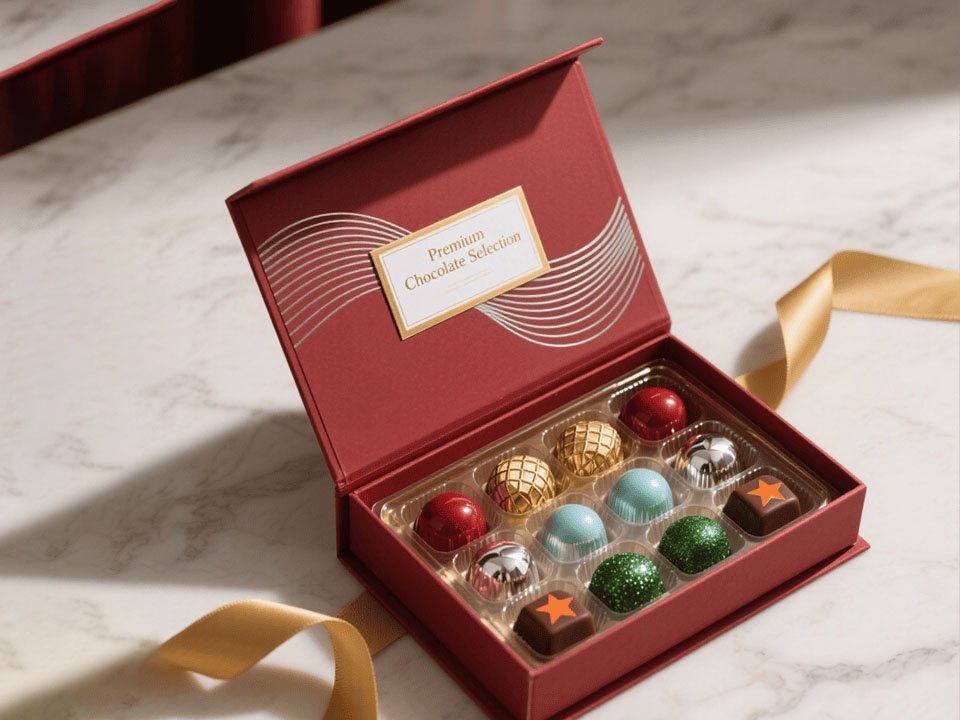
Eco-friendly gift box packaging reduces environmental impact through responsible material sourcing, efficient construction, lower material use, appropriate printing, optimized logistics, and realistic end-of-life recycling or reuse.
The entire packaging system should be evaluated rather than judging sustainability from one feature such as recycled paper or kraft color.
There is no single best material. Recycled paperboard, FSC-certified paper, kraft paper, corrugated board, and molded fiber can all be suitable depending on the product and packaging structure.
The best option balances protection, material efficiency, printability, sourcing, logistics, and end-of-life processing.
Not necessarily.
Recycled fiber describes the source of the paper, not the recyclability of the finished package. Plastic film, foam, windows, magnets, adhesives, coatings, and other components can affect how easily the packaging can be processed.
No. FSC certification and recycled content are different specifications.
FSC chain-of-custody certification relates to controlled sourcing and tracking of eligible forest-based materials. Recycled content should be specified separately when it is required.
Not automatically.
Brown kraft may require less bleaching or provide a natural appearance, but color alone cannot determine sustainability. Board weight, fiber source, coatings, laminations, inserts, adhesives, transportation efficiency, and recyclability also matter.
Dark, muted, natural, and intentionally restrained colors are often easier to manage, but the result depends on the actual substrate.
Recycled paper shade and absorption can influence printed color. Brands requiring strict Pantone matching should approve production color on the specified paper.
They are ink systems selected to reduce environmental impact while meeting printing, safety, durability, and recycling requirements.
Water-based, vegetable-based, alternative-oil, and other ink technologies may be appropriate depending on the printing process and packaging application.
Avoid unnecessary lamination, but do not remove it without considering performance.
Lamination can complicate a paper package’s material structure, yet it may also provide required abrasion or moisture resistance. Test alternative coatings or papers before making the change.
The PPWR pushes packaging sold in the EU toward recyclability, material efficiency, waste reduction, and stronger design-for-recycling requirements.
Regulation (EU) 2025/40 generally applies from August 12, 2026, with recyclability performance requirements becoming increasingly significant toward 2030.
Approve the exact production substrate, not just the artwork and Pantone number.
Specify the paper manufacturer, grade, grammage, surface treatment, recycled-content requirement, and approved physical sample. Require approval before suppliers substitute materials.