Talk To Our Boss If You Didn't Find The Solution
Our boss, Alanna will ask our team to find out the solution very soon! You must be satisfied with our services!


Electronics packaging has two jobs that don’t always like each other.
One job: keep the product alive through parcel chaos—drops, corner hits, vibration, stacking, the whole ride.
Other job: make the unboxing feel clean—centered product, tidy accessory bays, zero rattles, no “cheap” vibes.
If you try to solve both with one material, you’ll usually overpay somewhere: too much foam, too much board, too many parts, too many returns.
So here’s the point of this article: design inserts like a system. Start with shipping reality, then engineer protection, then shape the experience. And yes, you can still keep it eco-friendly and scalable.
When you’re ready to build the whole thing (inner box + insert + shipper), Zhibang Packaging can cover the full paper packaging stack—rigid boxes, folding cartons, corrugated shippers, mailers, and OEM/ODM production under ISO-style controls. Start here: Zhibang Packaging.
Let’s talk route first, because route decides everything.
If your electronics ship as individual parcels (DTC, retail replenishment, 3PL pick-pack), ISTA 3A is one of the most common ways teams sanity-check packaging for that lane. It targets parcel delivery shipments 150 lb (70 kg) or less.
That number matters because it tells you the abuse level you should assume. Don’t design for your warehouse. Design for the last-mile.
This is where teams mess up: they argue foam vs paperboard while nobody has agreed what “damage” means.
Do this instead:
When you do that, insert decisions get a lot less emotional.
Foam talk gets heated because people talk feelings. “This feels soft.” “This looks premium.” Cool, but your product doesn’t care.
A cushion curve connects peak acceleration (G) with static stress (weight divided by the bearing area). It basically tells you: “If you load this foam like that, how much shock gets through?”
Here’s the practical warning: many foams start bottoming out around 40–60% compression (and softer polyurethane can go higher). So if your insert design squeezes the foam too far at corners, you’re basically building a fancy hammer.
Simple rule: don’t “guess” foam thickness. Tie it to load and contact area, even if you’re doing quick prototype math.
Foam wins when protection is the boss.
Use foam inserts when:
If you want a luxury unboxing, you can pair foam with a premium paper box structure—rigid lid/base, clean printing, tight fit. This is where a paper packaging manufacturer like Zhibang Packaging fits naturally because they can build the full paper shell and tune the insert around it. See: Custom Paper Packaging Solutions and Products.
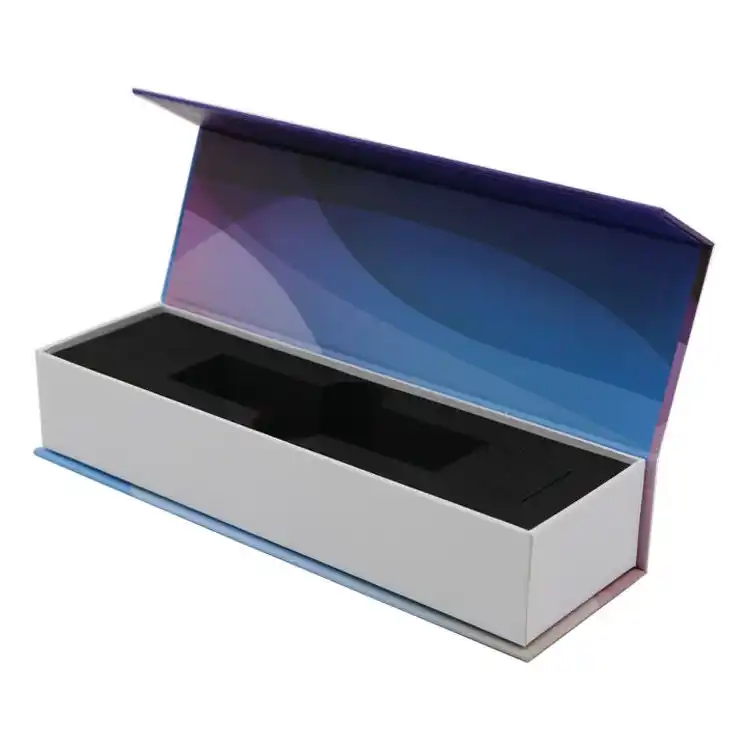
Paperboard inserts (greyboard, paperboard, corrugated partitions) don’t “cushion” like foam. They control movement and create structure.
Paperboard wins when your pain looks like:
Paperboard lets you design an “unboxing path”:
That’s not marketing fluff. It’s usability.
And when you pair paperboard inserts with a premium paper box, it looks sharp. If your brand sells on shelf and online, rigid + board inserts is a very common move. For that style, explore Luxury Gift Boxes (site category wording may vary) and Folding Cartons.
Most real projects end up here: hybrid inserts.
You use paperboard for structure and experience. You place foam only where it actually does work—corners, edges, impact zones. That gives you:
Hybrid is also friendlier to assembly:
If you ship electronics in a mailer, hybrid often pairs well with a corrugated outer. That’s where Shipping Boxes and Mailer Boxes (site naming may differ) come into play.
Molded pulp (molded fiber) sits in a middle zone:
The industry trend is clear: big brands publicly push toward fiber-based packaging and lower plastic usage in packaging.
But don’t treat molded fiber like magic. It still needs engineering:
If you’re switching from foam to molded fiber, do a reality check: drop risk, corner impacts, and abrasion points. Otherwise you’ll “save material” but increase returns, and that’s a bad trade.
This is the part that separates pretty prototypes from packaging that survives production.
If your insert needs three hand moves, a wrap, and a twist-lock, ops will hate it. And they’ll be right.
Insert designs should support:
At some point you must stop redesigning and lock the dieline. Every extra revision eats lead time and makes suppliers guessy.
So: iterate fast early, then lock hard.
Build a simple QC gate that checks:
Zhibang Packaging’s positioning around quality systems and scalable manufacturing matters here, because inserts punish sloppy tolerances. If you’re doing OEM/ODM and you need repeatability across runs, that’s the real value, not the pretty mockup. Check OEM/ODM Packaging and Need a Quote.
Use this matrix when your team is stuck.
| Insert type | Best at | Trade-offs | Best-fit scenarios |
|---|---|---|---|
| Foam inserts (EVA/EPE/PU) | Shock control, fragile protection | Can look industrial; can slow pack-out | High drop risk, high value devices |
| Paperboard / greyboard inserts | Presentation, structure, low rattle | Less true cushioning than foam | Premium unboxing + moderate transit stress |
| Molded pulp inserts | Fiber story + shaped cradle | Needs careful geometry; may scuff if poorly designed | Eco-led brands, stable shapes, controlled routes |
| Hybrid (foam + paperboard) | Target cushioning + clean look | More design work upfront | You need protection and a premium experience |
| Proof point | Why you care |
|---|---|
| ISTA 3A targets parcel shipments up to 150 lb (70 kg) | Sets the “abuse expectation” for insert design |
| Cushion curves link G vs static stress | Turns foam choice into a measurable decision |
| Foam bottoming out often begins around 40–60% compression | Prevents “soft but useless” cushioning |
| Large brands report shifting toward fiber-based packaging | Signals where buyer expectations are going |
| ISO-style quality controls reduce tolerance drift | Inserts need repeatability, not surprises |
(These are industry-standard facts from packaging test standards and manufacturer technical references; see the reference list at the end.)
If you only buy an insert, you still have a problem: the box and shipper might fight it.
What works better is a matched system:
Zhibang Packaging sits in a good place for this because they’re built around paper packaging—rigid presentation boxes, folding cartons, and shipping solutions—so you can design the whole stack together instead of patching it later. Start with Wholesale Custom Paper Packaging Solutions and browse Products. If you already have dimensions and weights, go straight to Need a Quote.
| Step | What to decide | What to test |
|---|---|---|
| Route definition | Parcel vs pallet, drop risk, stacking | Basic drop + corner hit checks |
| Damage definition | Cosmetic vs functional fail | Post-test inspection rules |
| Insert concept | Foam, board, molded fiber, hybrid | Shake test + abrasion check |
| Line readiness | Pack-out steps, error-proofing | Timed pack-out trials |
| Dieline lock | Final dimensions + tolerances | Pilot run validation |
| QC gate | Fit, glue, print, rattle | Sampling plan for production |
That’s it. Not fancy. Just effective.