Talk To Our Boss If You Didn't Find The Solution
Our boss, Alanna will ask our team to find out the solution very soon! You must be satisfied with our services!


It’s the paper.
Because once you strip away the logo, the ribbon, the “bespoke” talk, what you’re really selling is tactile credibility—stiffness, sound, edge crispness, scuff resistance, and how the bag behaves when it’s loaded with 2–5 kg and swung like a weapon through a mall.
Why do so many “high-end paper gift bags” still feel cheap the second you touch them?
I’m going to say the uncomfortable part out loud: most luxury paper gift bags fail at procurement, not design. The mood board gets signed off, the mockup looks great under studio lights, then someone quietly swaps the paper spec, downgrades lamination, or “optimizes” the handle patch… and you’ve just built a premium-looking liability.
Now add regulation pressure. In the EU, the Council adopted new packaging-and-waste rules on December 16, 2024, and it explicitly flags restrictions on “substances of concern,” including PFAS thresholds for food-contact packaging.
And in Minnesota, the state’s PFAS rules are blunt: intentionally added PFAS in food packaging is prohibited as of January 1, 2024 (and “food package” includes bags, coatings, inks, and labels—read the definition, it’s wide).
Even if your luxury gift bag isn’t for food, brands increasingly write one global spec to avoid region-by-region chaos. That’s the real reason compliance belongs in your materials conversation, not in your legal team’s inbox after the PO.
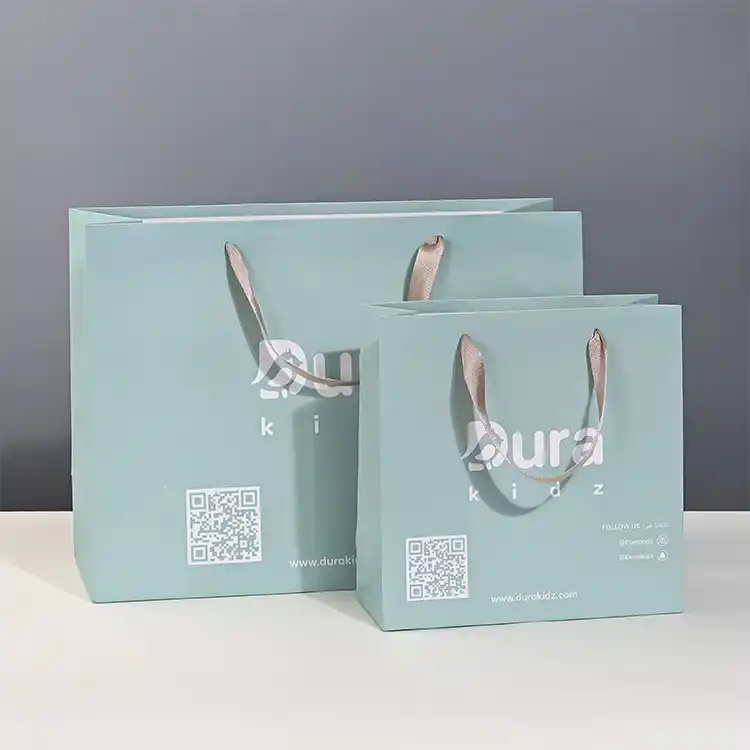
Premium paper gift bags aren’t one paper. They’re a stack:
If you want visual references of how manufacturers present the “luxury spec” (rope handles, metallic logos, clean folds), look at Zhibang’s own examples like luxury paper gift bags with rope handle and gold logo and customized luxury paper gift bags for jewelry—those product pages basically telegraph what buyers actually pay for: rigidity + finishing + handle execution.
People love asking about “gsm for paper gift bags” like there’s a single luxury number. There isn’t. But there are ranges that stop you from embarrassing yourself.
Here’s the hard truth: GSM alone is not stiffness. Fiber type, caliper, coating, lamination, and grain direction matter. Still, GSM is the fastest proxy you can put into a spec sheet that procurement can’t “interpret creatively.”
If you’re building thick cardstock gift bags (the ones that stand like a box), you’re usually in one of these approaches:
And yes, consumers notice. A 2023 Clemson University study on premium finished paper packaging reported statistically significant effects (e.g., foil finish and touch-related variables) on consumer behavior measures, with results like p < 0.05 showing up in their analysis.
Paper pricing moves. Your bag cost moves with it. Pretending otherwise is how brands get blindsided mid-season.
U.S. producer-price indexes tell the story in ugly numbers:
And the broader producer-price environment wasn’t flat either: BLS reported final demand PPI increased 3.3% in 2024 after 1.1% in 2023.
So when a supplier quotes you “soft-touch matte + 2-color foil + 250 gsm,” you don’t just ask the unit price. You ask what happens if pulp spikes, if film prices change, if they swap the board grade without telling you.
Luxury leaders pushed prices aggressively. A Reuters Breakingviews note cites HSBC analysts estimating luxury goods prices increased 54% on average between end-2019 and September 2024 (tracking iconic products in France).
That matters for luxury paper gift bags because packaging becomes part of the courtroom of consumer perception: if the product price screams “elite” and the bag whispers “mid,” you’ve created a mismatch customers feel before they think.
So yes—your “luxury gift bag materials” are brand strategy now, not a postscript.
I’d spec like a skeptic:
If you want a manufacturer-facing overview of common substrate families (paperboard, specialty papers, etc.), Zhibang’s explainer common raw materials used in packaging is a decent starting taxonomy—just don’t confuse “listed materials” with “luxury-grade execution.”
| Material / Build | Typical GSM / Core | High-end feel | Finish compatibility | Best use case | Watch-outs |
|---|---|---|---|---|---|
| Coated art paper wrap + board core | 157–200 gsm wrap + 300–400 gsm board | Very stiff, crisp folds | Foil, emboss, spot UV, matte film | Jewelry, cosmetics, premium gifting | Heavier shipping weight; fold cracking if over-coated |
| Heavy laminated paper (no board) | 200–250 gsm | Structured but lighter | Matte film, spot UV, foil | Fashion retail, boutique takeout | Handle patch must be specified or it tears |
| Textured specialty paper | 140–250 gsm (varies) | Instant “expensive” tactile | Foil can pop; printing can be tricky | “Quiet luxury” branding | Ink holdout issues; cracks on folds if grain ignored |
| Uncoated premium paper | 160–220 gsm | Soft, natural, upscale | Deboss/emboss great; film optional | Eco-forward luxury | Scuff risk without protection; color shifts |
| Kraft (premium grades) | 170–250 gsm | “Organic luxury” when done right | Limited color pop; emboss works | Sustainable positioning | Cheap kraft reads “grocery,” not “luxury” |
| Thick cardstock gift bags (board-heavy) | 350–450 gsm total build | Rigid, box-like | High-end finishes all work | High-value gifts, VIP events | Cost; storage volume; overkill for small items |
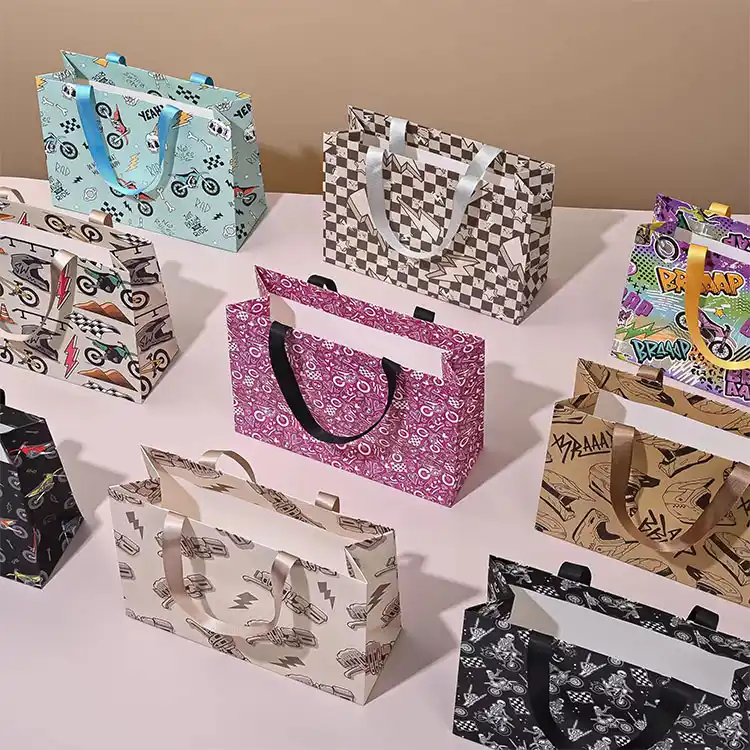
If you’re hunting for design patterns that retailers are actively using (the stuff that sells in stores, not in mockups), Zhibang’s trendy paper bag designs for retail is useful to benchmark handle types, finishes, and silhouette choices before you lock your spec.
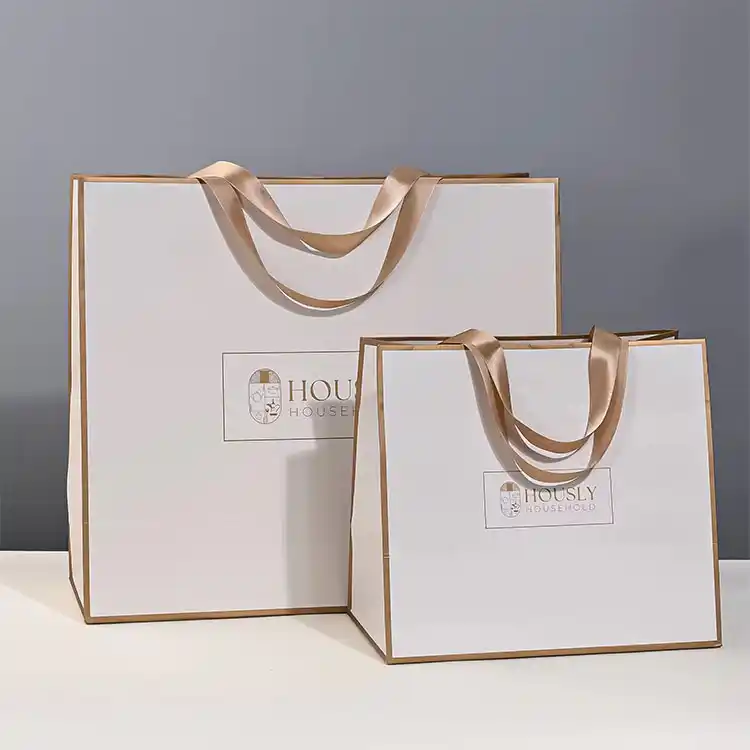
The best material for high-end paper gift bags is usually a coated or specialty outer paper (about 157–200 gsm) wrapped around a rigid paperboard core (roughly 300–400 gsm), finished with matte lamination or a premium coating, because this build prints sharply, holds shape, resists scuffs, and supports reinforced handles under real carry loads.
After that baseline, you choose texture vs. print clarity, and you test for fold cracking and scuffing—because “looks good flat” is not “looks good after a weekend in someone’s trunk.”
Luxury GSM for paper gift bags generally means an outer sheet in the 157–250 gsm range paired with structural reinforcement (board inserts or a full board core) so the bag stays upright, edges stay sharp, and the handle area doesn’t deform, since GSM alone doesn’t guarantee stiffness without caliper, grain control, and lamination.
If you want a quick safe spec: 200 gsm outer + board where needed + reinforced handle patch.
Choosing materials for luxury paper gift bags means selecting a paper stack that matches your load, finish, and compliance needs—outer paper for appearance, core/insert for stiffness, coating for durability, adhesive for humidity tolerance, and handle reinforcement for tear resistance—then validating it with scuff, drop, and handle-pull testing before mass production.
And yes, testing costs money. Reprinting and re-shipping costs more.
PFAS are a concern for luxury gift bag materials when coatings, inks, grease-resistant treatments, or barrier layers are used—especially for food-adjacent retail—because regulators increasingly target “substances of concern,” and Minnesota’s prohibition on intentionally added PFAS in food packaging took effect January 1, 2024, with broad definitions that can include bags and coatings.
If your supplier can’t provide a clear material declaration, treat that as a red flag, not a negotiation point.
Premium paper gift bags scuff even with lamination because matte and soft-touch surfaces trade friction for aesthetics, and scuffing is driven by film hardness, surface energy, handling abrasion, and print/varnish chemistry, so a “matte look” can still show white rub marks unless you specify anti-scuff film or protective coatings and validate in transit-like testing.
The fix is usually spec-driven: film grade, coating choice, and handling controls—rarely “print harder.”
If you’re done gambling on vague “premium” language, start demanding spec sheets. Grab a baseline from Zhibang’s paper gift bags lineup, pick 2–3 constructions from the table above, and ask for material swatches + a printed mockup + a handle pull test result before you sign the big PO.