Talk To Our Boss If You Didn't Find The Solution
Our boss, Alanna will ask our team to find out the solution very soon! You must be satisfied with our services!


Handles fail first.
And when they fail, the bag doesn’t “wear out,” it betrays you—because the customer feels the tear, hears the rip, watches the product tilt, and silently re-prices your brand in real time, right there on the sidewalk.
So why do procurement teams still treat handles like a checkbox?
I’m going to be annoying about this: the handle spec is not a “nice-to-have.” It’s load transfer engineering dressed up as fashion. Most “premium” disasters come from one of three lazy choices: (1) no internal patch board, (2) the wrong adhesive for the coating, or (3) a finish stack (lamination + foil + UV) that looks expensive and behaves fragile under shear.
If you want a quick visual of what “finish-first thinking” looks like, peek at Zhibang’s own product examples: a 357 GSM art paper build with matte lamination and a foil/UV combo isn’t unusual anymore—what matters is how the handle is anchored into that structure, not how glossy the logo looks. You can see that premium spec language on pages like Custom Matte Black Luxury Paper Bag with Gold Foil Logo.
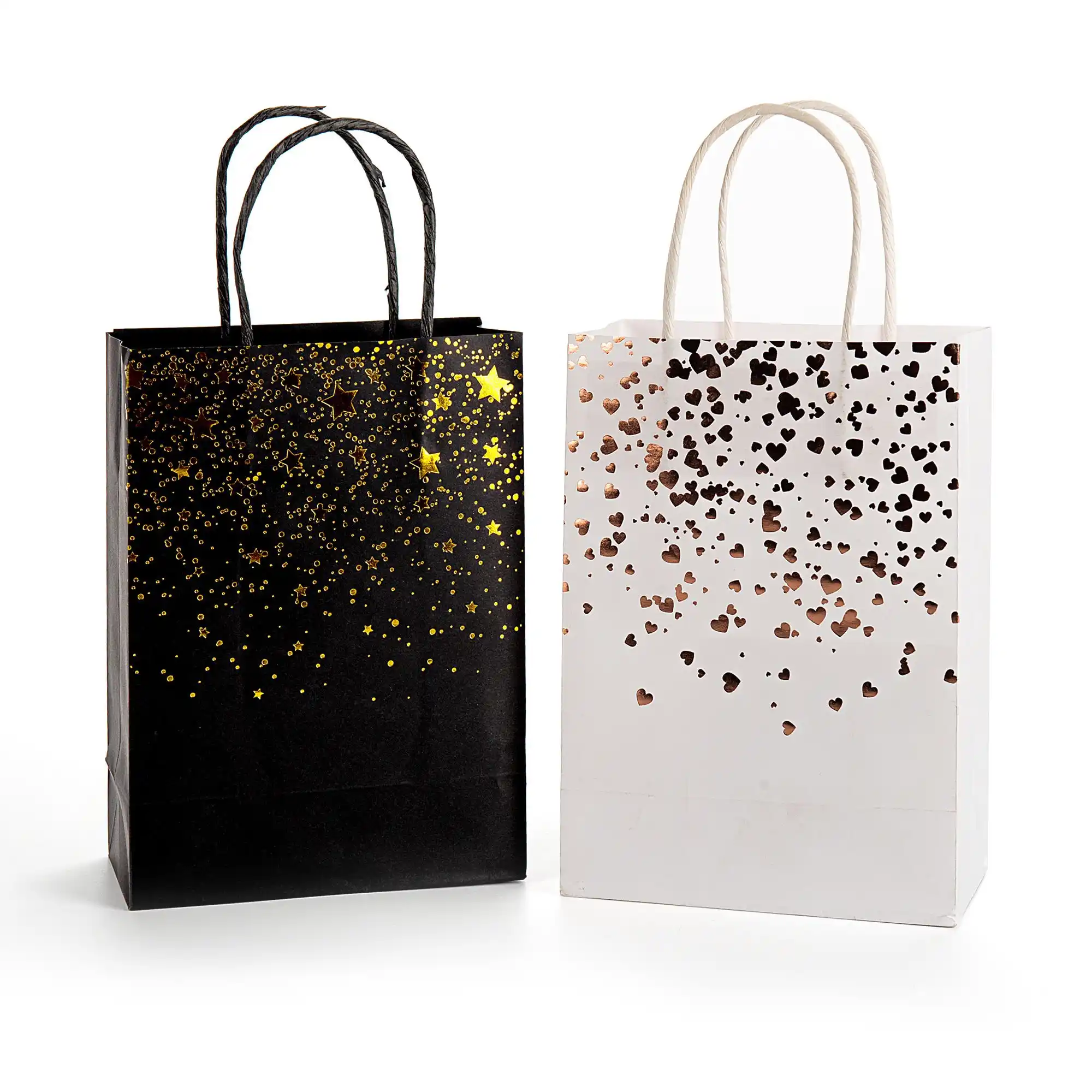
Here’s the hard truth: “luxury” handles are often less forgiving. They trade redundancy for aesthetics.
If you’re shopping within the Paper Gift Bags universe, you’ll see the same pattern: thicker papers, nicer finishes, and then wildly different handle outcomes depending on reinforcement discipline.
Pretty. Fragile when underspecified.
Ribbon handles do one thing brilliantly: they scream “gift.” Zhibang’s Luxury Gift Paper Bag with Ribbon Handles and Foil Logo makes the aesthetic case cleanly. But ribbons are also a stress concentrator when the hole is tight, the edge isn’t sealed, or the internal patch is thin. Satin + sharp paper edge + wet hands = slow-motion failure.
What I tell brand teams (and yes, it’s unpopular): if you want ribbon handles, pay for the internal patch board and a bigger hole geometry, or stop pretending you care about customer experience.
Comfort wins. Carry wins.
Rope handles (cotton rope, braided cord) distribute load better in the hand. They also cue “I can reuse this.” The common premium recipe—art paper + matte lamination + foil logo + rope handle—is basically the default for boutique retail now, and you’ll see specs like 1200 GSM rigid paper + 157 GSM art paper and hot foil on pages like Custom Luxury Paper Gift Bags with Rope Handle Gold Logo.
But rope can still rip out if the knot sits on raw paper without a proper patch, or if the glue line is sloppy. The handle doesn’t need to be strong; the interface does.
The retail workhorse.
Twisted paper handles are the “good enough” choice that becomes “actually great” when paired with sane reinforcement. They’re also easier to defend in recycling conversations—if you don’t suffocate the bag in plastic film lamination.
Zhibang even spells out the reality in their own write-up: twisted paper handles are the classic workhorse; rope reads more upscale; ribbon needs reinforcement to avoid embarrassment. See Custom Printed Paper Bags Online: Best Services for Branding Your Store.
Minimalist, cheap, risky.
Die-cut handles look clean and ship flat, but the stress is concentrated at the cut corners. You can “patch” it, sure—yet in practice, die-cuts are best for lighter payloads or short carries. If you’re pushing glass, cosmetics sets, or anything with hard edges, die-cut is where regrets begin.
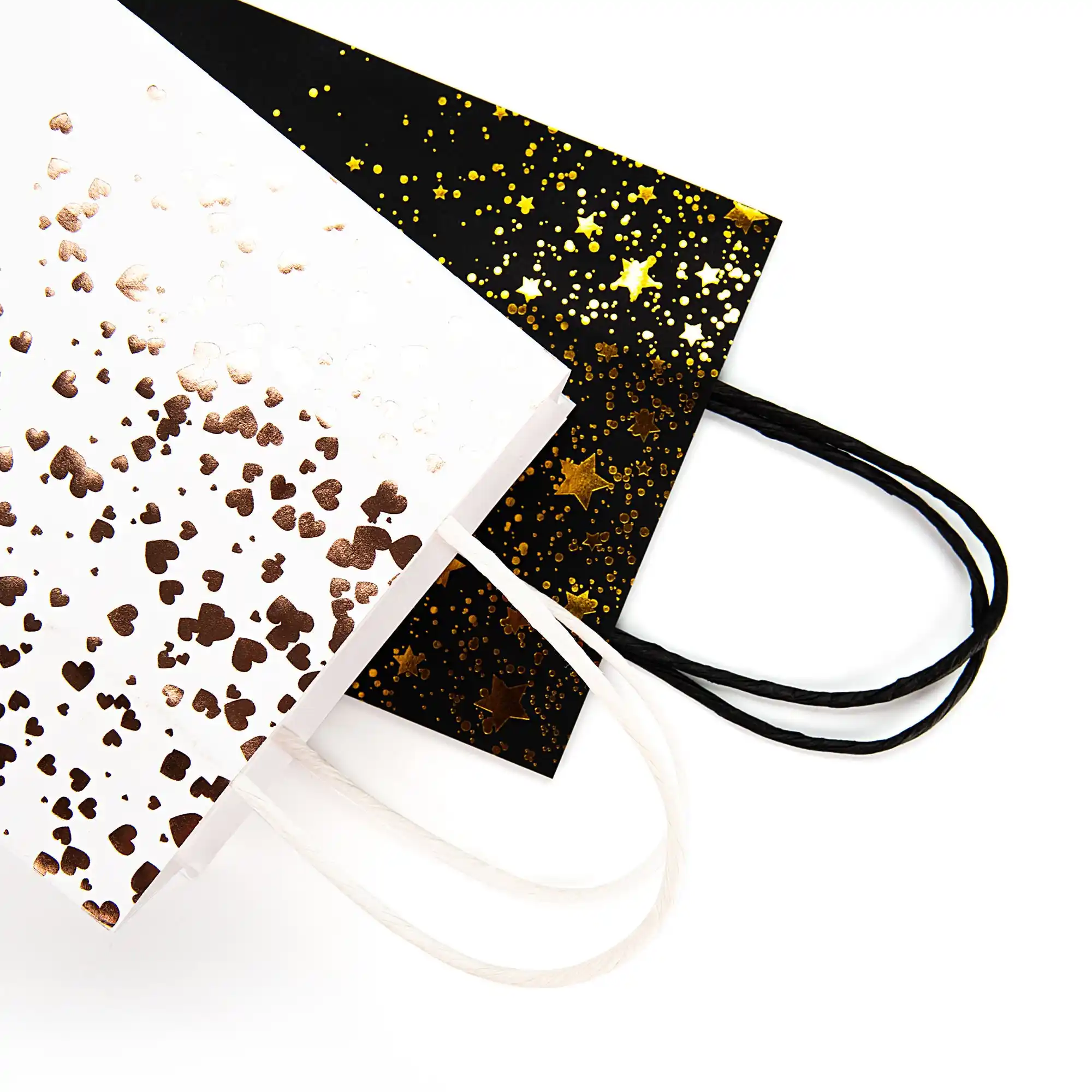
Hot foil is a classic flex. It’s also a compliance and recyclability conversation waiting to happen.
On paper, a foil logo is thin (microns), but the system adds complexity: adhesive layers, coatings, and sometimes laminated films. If you’re using matte lamination (often a BOPP film) plus spot UV, you’ve already moved the bag away from the simple “paper-only” story, even if the substrate is recyclable in principle. That’s why I’m suspicious of lazy eco claims.
Regulators are getting less patient.
In the EU, lawmakers have been pushing tighter packaging rules—Reuters reported a 2024 deal aimed at cutting packaging waste and restricting certain single-use packaging. EU provisionally agrees on law to cut packaging waste Later, the Council formally adopted the packaging and packaging waste regulation, framing it around less waste and more re-use. Council press release on sustainable packaging rules
And the green-claims squeeze is tightening too. Directive (EU) 2024/825 explicitly targets how environmental claims are presented to consumers. Directive (EU) 2024/825 (EUR-Lex) Reuters put it bluntly: this is about clamping down on misleading green messaging.
US side? The FTC has been publicly re-examining “recyclable” claims—its May 23, 2023 workshop was literally focused on recyclable advertising and the Green Guides review.
So if your bag is laminated, foiled, and UV’d, don’t write marketing copy that dares a regulator to ask follow-up questions.
One more uncomfortable topic: logos.
I see too many “inspired by” designs that are basically knockoffs in nicer paper. If you print somebody else’s trademark like it’s your own brand signal, you’re not being edgy—you’re being a liability magnet.
The U.S. Supreme Court’s decision in Jack Daniel’s Properties, Inc. v. VIP Products LLC (June 8, 2023) is a loud reminder that “parody” doesn’t automatically immunize you when the mark functions as a source identifier. Read the Court’s own opinion, not a blog summary.
Below are indicative ranges and failure modes—use them to interrogate quotes, not to pretend you’ve finished engineering.
| Handle type | Best for | Typical failure mode | Reinforcement you should demand | Cost pressure reality (ballpark) |
|---|---|---|---|---|
| Ribbon handle | Jewelry, cosmetics, VIP favors | Tear-out at hole edge; ribbon frays | Larger punched holes + internal patch board + sealed edges | Ribbon upgrade often adds complexity more than raw material cost |
| Rope handle | Apparel, heavier gift sets | Knot pull-through; patch delamination | Thick patch board + wide glue coverage + knot “stopper” | Often priced as “premium standard,” easy to overspend without better patches |
| Twisted paper handle | Retail workhorse, higher recyclability story | Handle unravels; patch tears under shock load | Good patch board + correct adhesive for coated stock | Usually cheapest “real handle,” but specs are where vendors cut corners |
| Die-cut handle | Light items, flat shipping | Stress cracks at cut corners | Patch layer or folded reinforcement panel | Lowest unit cost, highest return risk when payload creeps up |
| Embellishments (foil/UV/emboss) | Brand signaling, shelf impact | Scuffing; cracking on folds; “recyclable” claim trouble | Choose coatings intentionally; avoid plastic film if you need a clean recycling story | Plates/dies and setup drive cost more than ink |
If you want a handle-focused breakdown from the same supplier site, their article Five Core Elements and Material Selection Strategy of High-End Kraft Paper Handbags is unusually candid about matching handle types to duty cycle.

Custom paper gift bags are branded paper carriers—typically 250–400 GSM art or fancy paper with reinforced top folds, glued handle patches, and optional finishes like matte lamination or hot foil—that retailers use to turn checkout into a walkable ad while protecting products from crush and scuff damage.
After that definition, the only thing that matters is whether your handle spec is honest about payload, humidity, and carry distance. Most aren’t.
Ribbon handle paper gift bags use fabric or satin ribbons knotted or bar-tacked through the bag wall, while rope handle paper gift bags use twisted cotton or polypropylene cord anchored with internal patches; ribbons signal “gift,” ropes signal “carry weight,” and the engineering trade-off is tear-out vs. comfort.
If your product is heavy or boxy, rope is safer; if your brand is selling softness, ribbon can work—with reinforcement.
Twisted paper handles for gift bags are handles made from tightly wound kraft strands glued into loops and fixed with paperboard patches, and they’re generally recyclable in paper streams only when the bag avoids heavy plastic films, metal eyelets, or thick hot-melt glue blobs that trip screens at MRFs.
If you laminate with plastic film, your “easy recycling” story gets complicated fast.
Hot foil stamping on paper gift bags is a heat-and-pressure process that bonds a thin metallic or pigment foil layer onto a coated stock via an adhesive carrier, creating a crisp reflective logo (often gold or silver) that reads luxury at arm’s length but adds cost, setup time, and recycling complexity.
It’s worth it when your brand equity needs that flash; it’s wasteful when the bag is headed straight to a closet floor.
A die-cut handle paper bag is a paper bag where the grip is punched directly into the bag panel (sometimes reinforced with a folded patch), which keeps unit costs low and lines clean, but concentrates stress at the cut corners—so failures show up fast with sharp-edged boxes, heavy bottles, or wet hands.
If you’re shipping anything that can swing, knock, or soak, die-cut is playing with fire.
Replacing handles on a paper gift bag means removing the failed handle, reinforcing the inside wall with a new patch (ideally 400–800 gsm board), and re-threading a new ribbon or rope through cleanly punched holes so the load transfers to the patch—not the outer paper skin—then sealing knots and patch edges with PVA glue or hot-melt.
Do it neatly, or don’t do it—messy repairs look worse than a new bag.
If you’re buying custom paper gift bags and you can’t answer “what patch board weight, what adhesive, and what pull-test target,” you’re guessing with your brand’s reputation.
Start with real examples, then build a spec sheet. Browse Zhibang’s paper gift bag catalog and compare a ribbon-led option like ribbon handles + foil logo against a carry-first option like rope handle + gold logo.