Talk To Our Boss If You Didn't Find The Solution
Our boss, Alanna will ask our team to find out the solution very soon! You must be satisfied with our services!


Packaging breaks brands.
A premium box is basically a micro-logistics system: if the tray tolerances are sloppy, pieces rattle, edges chip, fillings smear, and you end up paying twice—once for “luxury” materials, and again for replacements, refunds, and reputation cleanup when customers open a disaster.
Still want to pretend the insert is “just an accessory”?
Here’s the hard truth I keep running into: most “premium chocolate gift boxes” are premium on the outside and weirdly careless on the inside. The box gets 1200 gsm board, foil, spot UV; the insert gets whatever was cheap that week. Then the brand acts shocked when a compartment chocolate box becomes a chocolate shuffleboard table in transit.
Cocoa didn’t politely stay stable in 2024. It spiked, violently.
Reuters reported London cocoa futures hitting 4,670 pounds/metric ton and New York futures $5,874/ton in early February 2024, with prices roughly doubling since the start of the prior year.
And by March 2024, Reuters was reporting plants cutting or stopping processing in Ivory Coast and Ghana, plus U.S. retail stores charging 11.6% more for chocolate products in 2023 versus 2022 (Circana data via Reuters).
So.
When ingredients jump like that, waste stops being a rounding error. Portion protection—keeping each piece isolated, stable, and clean—turns into cost control, not “nice packaging.”
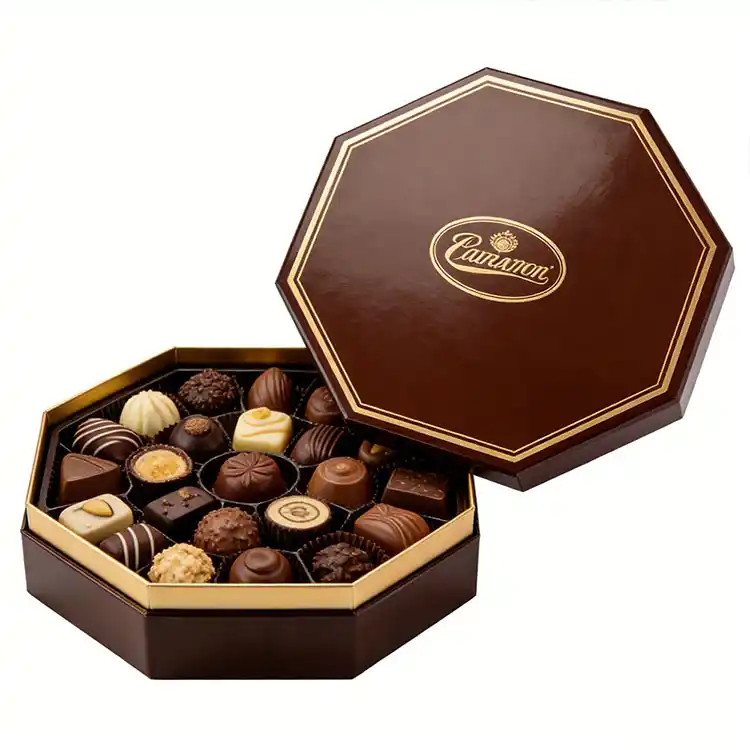
A “chocolate insert tray” isn’t decoration. It’s a set of decisions:
If you want a concrete example of how manufacturers talk about structure, look at Zhibang’s luxury 3-layer drawer gift box for chocolates or the more “classic retail” custom rigid lid-and-base chocolate gift box with insert. Same market. Different physics.
And yes—brands underestimate tolerances. Constantly.
Zhibang’s customer cases on thermoformed tray cavities even call out “precise tolerances” for heart-shaped cavities. That phrasing isn’t fluff; it’s the difference between a tray that cradles and a tray that bruises.
Here’s where I get opinionated: “assortment boxes” are a recurring liability because humans pack them, humans mis-pack them, and the consequences can be ugly.
In January 2024, the FDA posted a company announcement: Big Island Candies recalled 120 boxes of a brownie assortment due to undeclared peanuts, triggered by a portion of the box containing peanut-butter brownies instead of macadamia nut brownies—an error traced to the packing and labeling stage.
That’s not a branding problem. That’s a system design problem.
A better tray layout can’t fix every process failure, but it can reduce the probability of mix-ups by forcing one cavity = one SKU identity. When cavities are visually distinct, and the tray map matches the packing list, “portion protection” becomes an operational control.
If you’re selling premium chocolate gift boxes with allergen-sensitive assortments, don’t rely on vibes. Build a tray that makes the wrong piece look wrong.
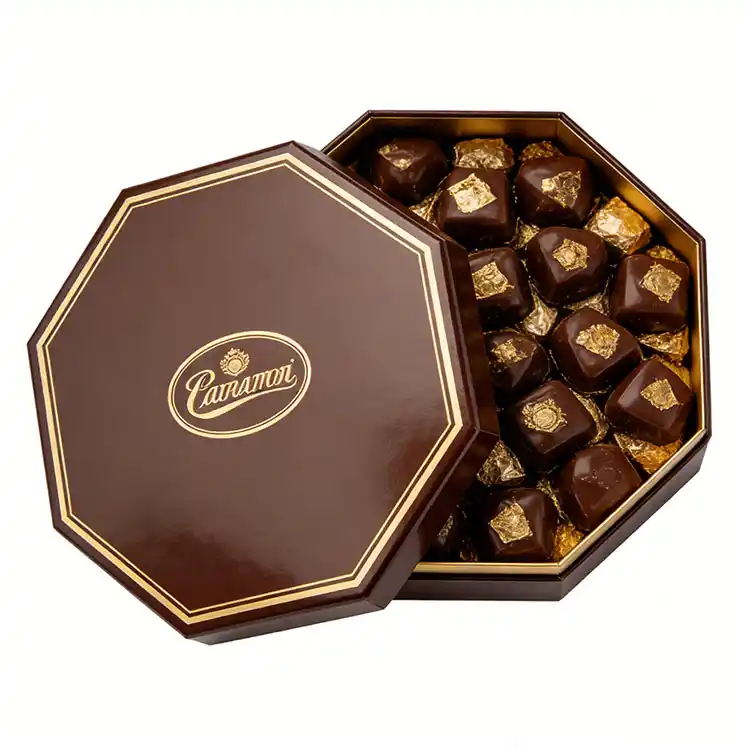
Chocolate is shelf-stable, but it’s not climate-proof.
Iowa State University Extension notes chocolate’s low water activity (a_w ~ 0.3–0.4) and recommends storage around 65–70°F with relative humidity below ~50–55%; it also points out sugar bloom comes from humidity/moisture and is more likely with refrigerated chocolate.
Translation: your insert has to help manage micro-environment, not just movement.
That means:
Want the design trend version? Zhibang’s write-up on modular inserts and multi-layer trays for chocolate packaging is basically the marketing translation of the same engineering reality: movement control + reveal sequence + repeatable packing.
| Insert Type | Typical Spec Range | Portion Protection | When It Wins | When It Bites You |
|---|---|---|---|---|
| Thermoformed PET tray (food-grade) | ~0.3–0.6 mm | High | Clean cavities, fast packing, crisp presentation | Looks “plastic” if you don’t dress it with color/foil; tooling lead times |
| Paperboard divider grid | ~300–600 gsm board | Medium | Eco-forward positioning, warm tactile feel | Warps with humidity; edges can abrade delicate shells |
| Molded pulp tray | varies by mold | Medium | Sustainability story, shock absorption | Surface texture can mark glossy chocolate unless lined |
| EVA/foam insert (non-contact use) | 1–5 mm | High (for jars/items) | Great for non-food-contact components (jars, accessories) | Not ideal for direct chocolate contact; needs barrier layer |
| Gold-laminated paper tray | board + film | Medium–High | “Luxury” signal, better scuff resistance than raw board | Film wrinkles if die-lines are sloppy; fingerprints show |
If you want examples of “premium + insert” combinations, compare Zhibang’s custom cardboard lid-and-base chocolate gift box with insert with their broader eco-friendly gift packaging solutions page—same gifting category, different insert narratives.
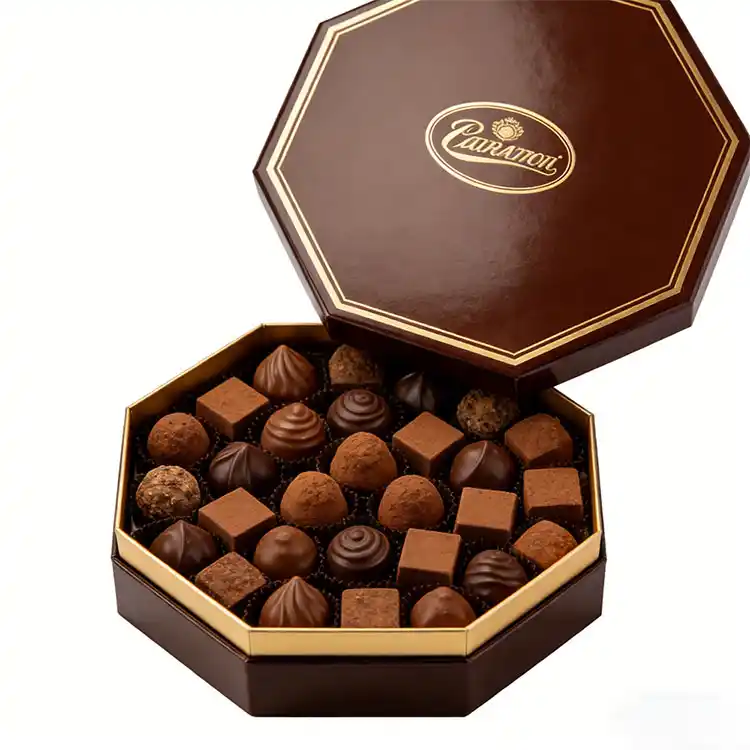
Portion protection in chocolate gift boxes is the packaging system—tray cavities, dividers, headspace control, and barriers—that keeps each individual piece isolated from impact, smear transfer, odor pickup, and allergen mix-ups while preserving the intended presentation from packing line to unboxing, including during vibration and temperature swings.
In practice, it’s “one piece, one seat, one clean reveal.” If your chocolates can slide, touch, or rotate, you don’t have portion protection—you have roulette.
A chocolate box tray layout is a mapped cavity system (dimensions, spacing, and layer structure) engineered to seat each piece with controlled clearance, prevent movement under shipping vibration, and stage the assortment visually so customers perceive order, variety, and abundance without the chocolates contacting each other or the lid.
Start with your actual piece dimensions, then design around the worst-case piece (tallest, most fragile). And don’t skip a packing diagram—operators will improvise, and you won’t like the result.
The “best” insert for luxury chocolate gift boxes is the one that matches your risk profile: thermoformed PET trays typically maximize stability and cleanliness, while paperboard dividers prioritize sustainability cues; the right choice depends on humidity exposure, surface gloss sensitivity, and whether you need precise cavities or flexible compartment sizing.
If you sell glossy bonbons and ship far, trays usually win. If your story is eco-first and your pieces are rugged, dividers can work—if you control humidity.
Chocolate box inserts help prevent bloom and quality loss by reducing surface abrasion, limiting exposure to moisture and odor migration, and stabilizing the product so temperature-driven softening doesn’t turn into smear transfer; when combined with proper outer box sealing, inserts support the storage conditions that reduce sugar bloom risk.
They don’t replace temperature control. But they stop minor handling issues from becoming visible defects, which is what customers punish you for.
When assortments aren’t physically separated, the real-world risks include mis-packing and allergen exposure, cross-contact through smear transfer, and customer-facing “wrong piece” disputes that look like quality fraud; in 2024, the FDA posted a recall involving an assortment box where undeclared peanuts were tied to a packing/labeling error.
The awkward part: the mistake might be rare, but the screenshot spreads fast. Separation is cheap insurance.
If you’re selling chocolate gift boxes and you’re still treating the insert like an afterthought, you’re budgeting backward. Start with the tray layout, then pick the outer box that makes it look expensive.
Want a reference point for real formats? Review Zhibang’s rigid chocolate gift box packaging with inserts, then spec your cavity map, tolerances, and layer structure before you approve finishes. Your customers will never praise “0.8 mm clearance.” They’ll just stop complaining.