Talk To Our Boss If You Didn't Find The Solution
Our boss, Alanna will ask our team to find out the solution very soon! You must be satisfied with our services!


Chocolate gift packaging has an unusual job.
It has to sell an emotion, protect a fragile food product, survive distribution, communicate flavor and brand position, and still look nearly perfect when somebody finally opens it. A box can be visually impressive on a designer’s screen and still fail badly in the real world.
That matters in a very large category. According to the National Confectioners Association’s 2026 State of Treating, chocolate generated approximately $28.4 billion in U.S. sales in 2025, accounting for 51.7% of confectionery sales. The same research found that 82% of consumers want holiday-specific confectionery products featuring special packaging, shapes, and flavors. Packaging is not a minor accessory to the product here. For gifting and seasonal programs, it is part of the product experience itself.
So which chocolate packaging ideas actually deserve a buyer’s attention?
The strongest concepts combine visual impact with manufacturing reality: dimensions, insert tolerances, filling efficiency, food compatibility, logistics, sustainability, tooling cost, and SKU flexibility.
Here are eight approaches worth considering.
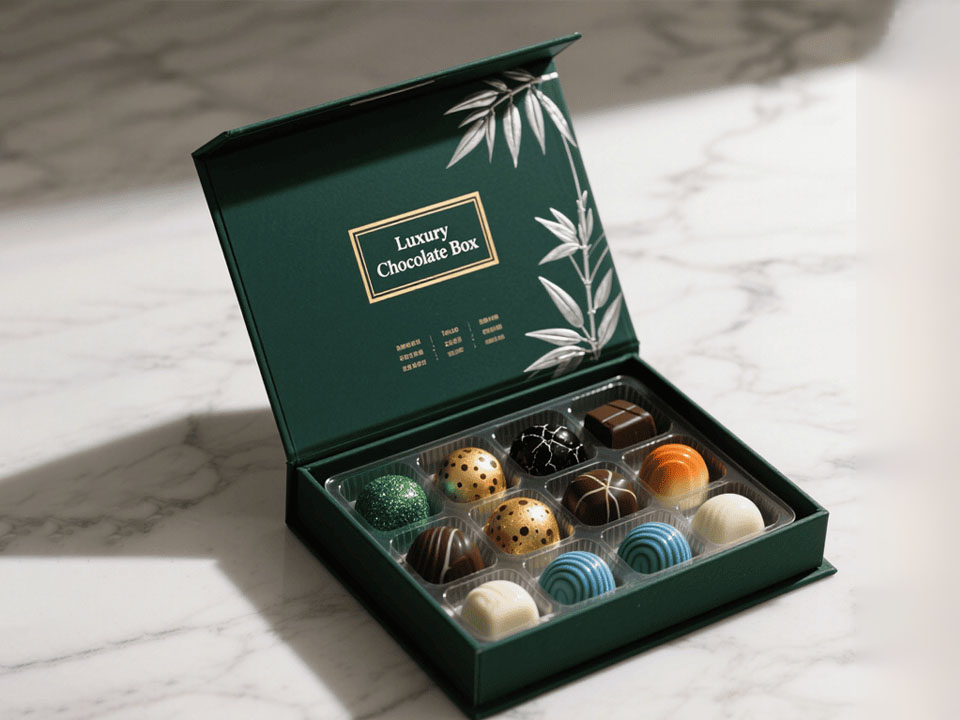
This sounds obvious. It gets ignored surprisingly often.
Recently, while reviewing packaging discussions, I came across a chocolate-box failure that every packaging buyer should take seriously: the chocolates literally did not fit the cavities designed for them. The pieces overlapped the cavities and sat awkwardly instead of creating the clean presentation everybody expected.
People with packaging experience immediately recognized the likely problem. Either the chocolate dimensions changed after the packaging was finalized, or approximate dimensions had been used instead of validated production samples.
The outer box could have been beautiful. It did not matter.
Once the chocolates were crooked, loose, crowded, or sitting at inconsistent heights, the premium effect disappeared.
This is why I would not approve a chocolate gift box from CAD drawings alone. Before mass production, I want:
Chocolate dimensions can vary slightly because of molds, inclusions, coatings, decoration, temperature, or manufacturing tolerances. Your packaging engineer needs to design for the real dimensional range rather than one perfect nominal measurement.
For custom chocolate gift boxes, this is especially important when assortments contain several shapes or sizes. A round truffle, molded praline, chocolate square, and coated nut cluster should not automatically share the same cavity geometry.
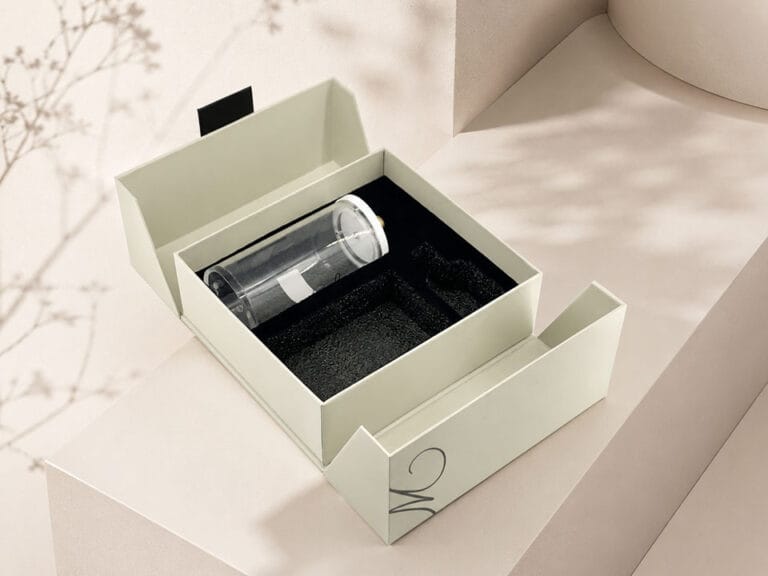
The insert is not just a holder. It determines alignment, movement, presentation height, finger access, product spacing, and how controlled the entire box feels.
Ask your packaging supplier these questions before approving the tray:
A 1–2 mm decision can sometimes matter more than an expensive decorative finish.
A single tray shows everything immediately. A layered box creates discovery.
For premium assortments, consider two levels of chocolates separated by a rigid paperboard platform, lift tab, thin divider, or removable tray. The first layer introduces the collection. The second layer creates the surprise.
The concept works particularly well for:
But there is an engineering catch. Two layers increase vertical stack-up tolerances.
If the upper tray sits too low, it can contact the chocolates beneath it. If it sits too high, the package becomes unnecessarily deep and begins shipping air.
A good chocolate box packaging design balances product height, divider thickness, lid clearance, tray stiffness, and presentation.
This is also where structural prototypes become much more useful than renderings. A rendering cannot tell you whether the consumer’s fingers can actually lift the first tray without tipping half the chocolates.
The two layers do not have to be identical.
For example:
Top layer: signature chocolates and recognizable flavors Bottom layer: experimental flavors, seasonal editions, or chef selections
That structure creates a reason for the customer to keep exploring rather than simply increasing piece count.
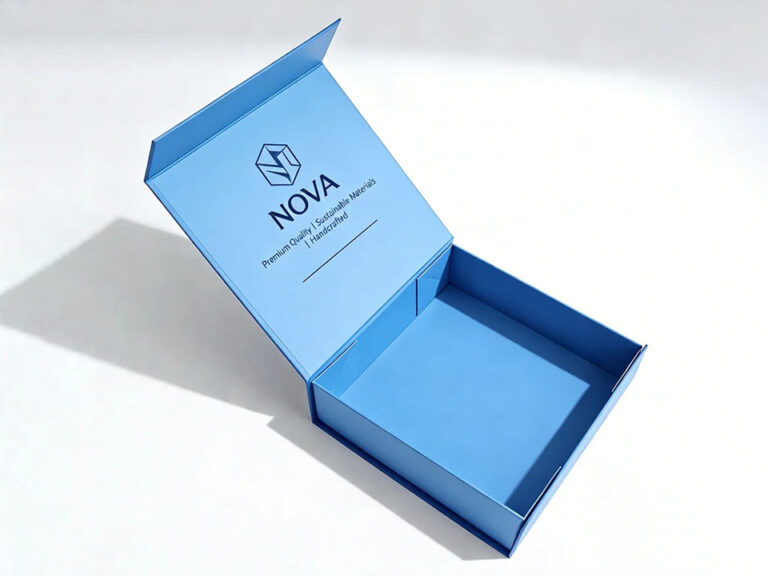
Magnetic closure boxes remain one of the strongest formats for premium gifting because the opening action feels deliberate. The board thickness, wrapped construction, hinge movement, and magnetic closure immediately separate the package from a standard folding carton.
They are a logical option for luxury chocolate packaging when the assortment has enough retail value to justify the package.
The mistake is assuming that adding magnets automatically makes a box premium.
It does not.
A poorly engineered magnetic box can create new problems: excessive material use, bulky shipping volume, weak corners, misaligned lids, overly strong magnets, visible magnet impressions, or a box that costs more to freight than expected.
For B2B buyers, look beyond the sample-room wow factor.
Ask for the packed dimensions, unit weight, master-carton quantity, pallet efficiency, magnet specification, board thickness, hinge construction, and closure performance after repeated opening.
Luxury chocolate packaging often improves when designers remove elements rather than add them.
A strong combination might be:
That can look considerably more expensive than combining foil, spot UV, embossing, ribbons, multiple patterns, metallic board, and oversized logos on one package.
Restraint gives the product room to look expensive.
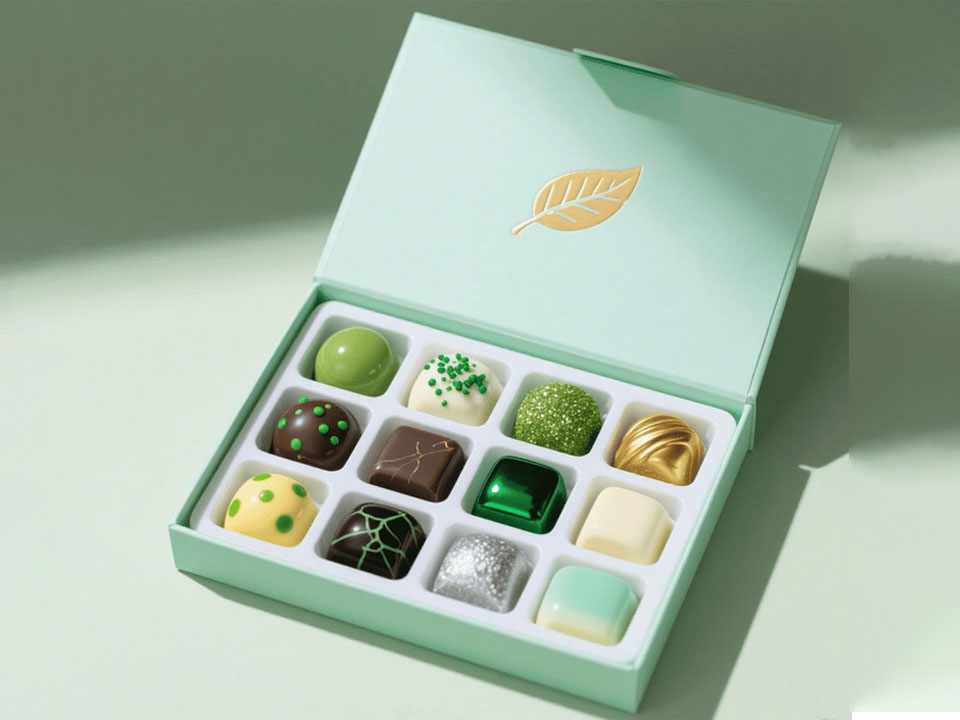
Drawer boxes work because opening the package becomes physical. The customer pulls. The chocolates appear gradually.
That makes the structure useful for gift assortments where presentation matters as much as shelf visibility.
The design can include a ribbon pull, thumb notch, paper pull tab, or exposed drawer edge. Sleeves can carry most of the printing while the internal drawer stays relatively simple.
There is another advantage for brand teams: the sleeve and drawer can sometimes be treated as separate design zones.
The outside tells the brand story. The inside delivers the product.
That gives creative chocolate packaging more room to communicate without printing every message on the main front panel.
Still, drawer friction needs testing.
Too loose and the tray can slide out during handling. Too tight and the customer has to fight the box. Paper wrapping, board tolerances, humidity, lamination, and assembly variation can all change how smoothly the drawer moves.
Specify a target opening feel during sampling instead of merely approving dimensions.
Seasonal packaging sells chocolate, but completely redesigning the structural package for Valentine’s Day, Easter, Mother’s Day, Halloween, Christmas, corporate gifting, and regional campaigns can create an ugly inventory problem.
A more flexible approach is to standardize the core structure and change the visible communication layer.
Keep the same:
Then change:
This is particularly useful because seasonal demand really does influence confectionery purchasing. NCA’s 2026 research reports that 82% of consumers want holiday-specific products with special packaging, shapes, and flavors.
The commercial advantage is straightforward. The brand gets visible seasonal differentiation without rebuilding the entire packaging BOM every few months.
That can reduce obsolete stock as well.
If your Valentine’s Day forecast is wrong, being stuck with 20,000 printed paper sleeves is painful. Being stuck with 20,000 highly specialized rigid boxes and matching custom trays is much worse.
Here is one of the most underused chocolate packaging ideas: stop treating the insert as dead space.
Use the cavity arrangement to help customers understand the assortment.
Individual positions can correspond to:
A printed card can then map each position to the appropriate flavor.
For example:
01 — Madagascar 70% 02 — Sea Salt Caramel 03 — Hazelnut Praline 04 — Espresso Ganache
Now the customer does not have to guess which chocolate is which or hunt through dense text on the back panel.
For sophisticated assortments, the sequence itself can become part of the product experience. The chocolatier might guide the consumer from delicate flavors toward darker, stronger pieces, similar to a tasting flight.
This is where design and production need to communicate tightly. If factory workers can accidentally rotate the tray 180 degrees during packing, your flavor map suddenly becomes wrong.
Add a poka-yoke feature — a simple asymmetrical notch, corner radius, tab, or orientation mark — so the insert can only be packed correctly.
Small engineering detail. Big difference.
Sustainability claims are getting more specific, and buyers should pay attention.
McKinsey’s 2025 U.S. Packaging Survey, based on 1,000 U.S. consumers, found that 77% considered recyclability extremely or very important when evaluating packaging sustainability. 62% said the same about recycled content. Consumers in the survey viewed paper and cardboard as the second-most sustainable packaging material category after glass.
That suggests a shift in the way brands should approach sustainable chocolate packaging.
“Eco-friendly” is vague.
A packaging engineer should be asking much more specific questions:
Sometimes the most sustainable-looking box is not the easiest box to recycle.
A kraft exterior does not automatically solve a complicated material structure underneath.
This has become more relevant for brands selling into the EU. Regulation (EU) 2025/40, the Packaging and Packaging Waste Regulation, began applying from August 12, 2026, with requirements introduced on a phased basis. The regulation is intended to move EU packaging toward recyclability and includes design-for-recycling performance grades from 2030.
Under the regulation, recyclability performance will be expressed through grades A, B, and C. Packaging falling below the qualifying threshold is treated as technically non-recyclable under the relevant framework.
The regulation also addresses excessive packaging. For grouped, transport, and e-commerce packaging, the maximum empty-space ratio is scheduled to be 50% by January 1, 2030, or three years after the relevant implementing acts enter into force, whichever is later. Filling materials such as paper cuttings, air cushions, bubble wrap, foam fillers, and similar materials count as empty space for this calculation.
That changes the conversation.
An oversized luxury gift box may look dramatic today, but European-market packaging development increasingly needs to justify the material and space being used.
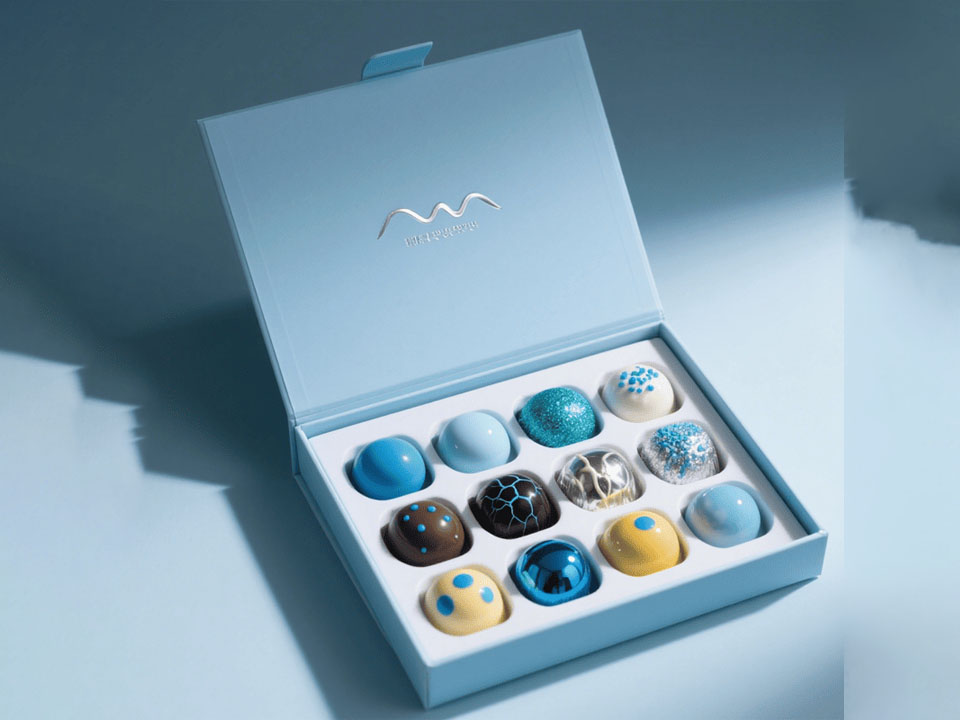
A beautiful chocolate box that arrives crushed is not premium packaging.
Neither is a presentation box that survives perfectly but requires an enormous corrugated shipper, foam blocks, air cushions, and three layers of protective wrap around it.
E-commerce changes the design target.
Instead of evaluating the retail box alone, test the entire packaging system:
Chocolate → insert → gift box → protective packaging → shipper → pallet or parcel network
Then look for weak points.
Corners are common failure areas. So are lids that separate under impact, drawers that slide open, inserts that release products under vibration, and excessive internal clearance that allows chocolates to gain momentum before hitting a cavity wall.
A shipping-ready gift box may need slightly stronger corners, tighter insert retention, better product spacing, or a different master-carton configuration.
It may not need a thicker box everywhere.
This is where packaging engineering saves money. Rather than adding material blindly, strengthen the places where failure actually occurs.
For some custom chocolate gift boxes, the best result may be a lighter presentation package paired with a highly efficient transit carton. For others, strengthening the gift box itself can reduce secondary protective materials.
Test both systems before locking the specification.
The right structure depends on price point, order volume, distribution channel, and the unboxing experience you want to create.
| Packaging Concept | Best For | Relative Complexity | Protection Potential | SKU Flexibility | Main Issue to Validate |
|---|---|---|---|---|---|
| Precision cavity tray | Pralines, truffles, molded chocolates | Medium | High | Medium | Product tolerances and removal |
| Two-layer gift box | Large premium assortments | High | High | Medium | Vertical clearance |
| Magnetic rigid box | Luxury gifting and corporate programs | High | High | Medium | Freight volume and construction |
| Drawer box | Premium retail and gifting | Medium-High | High | Medium | Drawer friction |
| Seasonal sleeve system | Holiday campaigns | Low-Medium | Depends on base box | High | Sleeve fit and inventory planning |
| Flavor-map insert | Tasting assortments | Medium | High | Medium | Packing orientation |
| Paper-focused recyclable structure | Sustainability-led brands | Medium | Medium-High | Medium | Full material composition |
| Shipping-optimized gift box | DTC and e-commerce | Medium-High | Very High | Medium | Transit testing |
Relative complexity is directional rather than a fixed cost ranking. Order quantity, box size, insert design, paper selection, printing method, finishing, assembly, freight, and packing labor can shift the economics significantly.
Most brands spend too much money making the outside of the box look luxurious and not enough engineering the inside.
I would rather remove one decorative finishing process and put that budget into a better insert.
A magnetic closure, gold foil, embossed logo, ribbon, complicated hinge, or unusual opening mechanism means very little if the chocolates look undersized in their cavities, move during transportation, break, rub against one another, or arrive looking disorganized.
That is the difference between decoration and packaging performance.
When professionals discuss actual chocolate packaging problems, the conversation quickly moves toward fit, product protection, food-contact materials, contamination risks, shipping conditions, packing efficiency, and dimensional consistency. Those subjects sound less glamorous than foil stamping.
They decide whether the packaging actually works.
I would therefore establish the project in this order:
Many projects are developed almost backward. Someone falls in love with a rendering first, and the engineering team is later asked to somehow make the chocolates fit inside it.
That creates avoidable compromises.
A better RFQ produces a better package.
Do not send a supplier a reference photo and ask, “How much for this box?” You will receive a price, but probably not a meaningful quotation.
A professional RFQ should include:
| Information | What to Provide |
|---|---|
| Chocolate dimensions | Length × width × height for every shape |
| Product tolerance | Minimum and maximum dimensions if available |
| Piece count | Chocolates per gift box |
| Arrangement | Rows, layers, assortment positions |
| Food protection | Primary wrap, cup, liner, or direct-contact requirement |
| Box style | Rigid, drawer, folding carton, book-style, etc. |
| Insert | Paperboard, molded pulp, plastic tray, other |
| Printing | CMYK, Pantone, interior printing |
| Finishing | Foil, embossing, debossing, UV, texture |
| Quantity | Initial order and expected annual volume |
| Markets | U.S., EU, UK, other destinations |
| Distribution | Retail, DTC, wholesale, corporate gifting |
| Shipping test | Requested test method or distribution scenario |
| Sustainability target | Recyclability, recycled content, plastic reduction, material reduction |
| Launch date | Required production-ready delivery date |
The more information you provide before structural engineering begins, the fewer surprises appear during sampling.
At minimum, perform a physical fit review using production-representative chocolates.
Then push the prototype harder.
Turn it upside down. Shake it. Open and close it repeatedly. Pack it into the proposed shipper. Stack cartons. Simulate handling. Leave the prototype under expected storage conditions and check whether papers, adhesives, coatings, inserts, or closures change.
For larger programs, formal transit testing should be discussed with your packaging engineers and logistics team based on the actual distribution route.
Do not approve the presentation box in isolation.
Approve the packaging system.
That approach is especially important with luxury chocolate packaging, because rigid gift boxes can make product failures more visible rather than less visible. Expectations are higher when the box itself signals premium positioning.
A customer opening an inexpensive folding carton may tolerate a little movement.
A customer opening a $70 gift box probably will not.
Creative chocolate packaging does not require eight mechanisms, five materials, three foils, and an unusual box that nobody knows how to open.
Start with the product.
Give every chocolate a defined position. Control spacing. Control movement. Think about how the customer’s hand approaches the product and what they see during the first three seconds after opening the lid.
Then add creativity where it improves that experience.
Sometimes that means a magnetic box. Sometimes a drawer. Sometimes a clever flavor map. Sometimes a seasonal sleeve. Sometimes the smartest decision is simply reducing the package size and improving the tray.
When structure, graphics, protection, manufacturability, logistics, and sustainability all support the same idea, the packaging stops feeling decorated.
It feels designed.
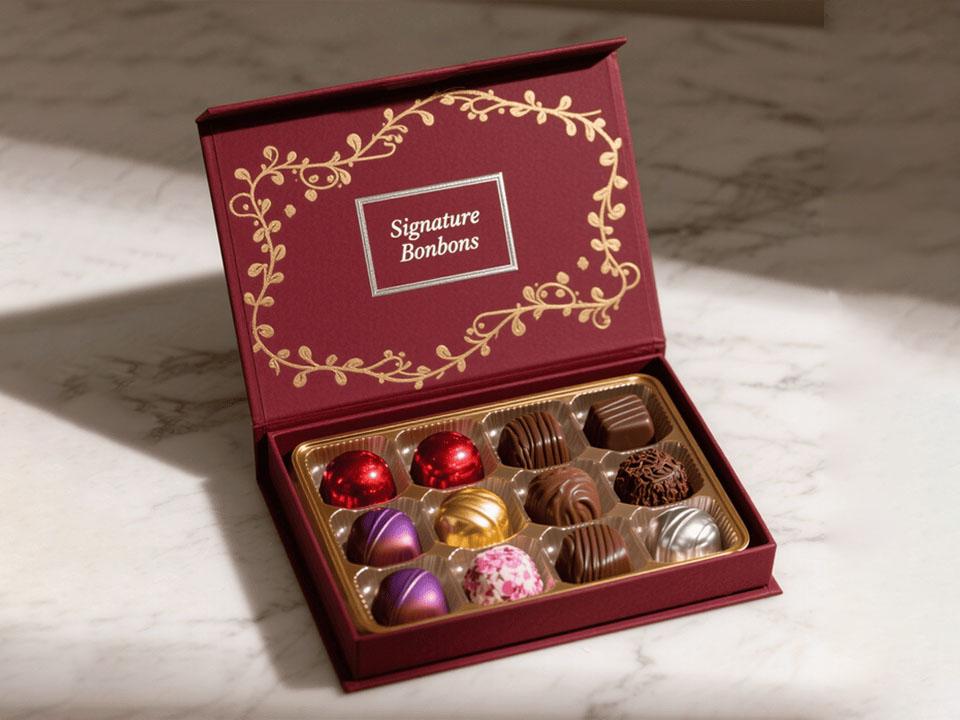
Short answer: Precision inserts, magnetic rigid boxes, drawer structures, layered trays, flavor maps, and restrained premium finishes are among the strongest options.
The right choice depends on chocolate dimensions, retail price, distribution method, order quantity, and the desired unboxing experience. Product protection should be established before decorative features are finalized.
Short answer: Accurate fit, controlled spacing, solid construction, clean printing, tactile materials, and restrained finishing usually create a stronger premium impression than excessive decoration.
Luxury is partly about precision. Straight edges, aligned chocolates, consistent gaps, smooth closures, and clean interior finishing can make a simple design feel more expensive.
Short answer: There is no universal best insert. The correct choice depends on chocolate shape, food-contact requirements, protection needs, sustainability goals, price point, and automated or manual packing processes.
Always test the insert with final or production-representative chocolates. Do not choose cavity dimensions solely from drawings.
Short answer: Magnetic rigid boxes work well for premium gifting, but they should be used when product value and brand positioning justify the added material, assembly, freight, and unit cost.
Evaluate the complete landed cost rather than comparing ex-factory box prices alone. Storage volume and shipping efficiency can materially change the economics.
Short answer: Reduce unnecessary material, improve recyclability, consider recycled content, simplify material combinations, optimize dimensions, and select inserts that support the intended recovery stream.
McKinsey’s 2025 U.S. consumer research found recyclability carries more weight with consumers than many broader sustainability attributes, making specific design decisions more meaningful than vague environmental messaging.
Short answer: Yes. Chocolate packaging sold in the EU falls within a packaging regulatory environment increasingly focused on recyclability, material use, waste prevention, labeling, and packaging minimization.
Regulation (EU) 2025/40 began applying on August 12, 2026, with several obligations and implementation dates phased over subsequent years. Brands developing packaging for future EU launches should incorporate those requirements during design rather than after tooling.
Short answer: Match cavity geometry to actual product dimensions, establish suitable clearance, secure the insert, control vertical space, and validate the package through handling and transport tests.
Do not assume a tighter cavity is always safer. Too little clearance can damage coatings or make chocolates difficult to remove.
Short answer: Usually not. A standardized core box combined with seasonal sleeves, bands, cards, ribbons, or replaceable graphics can create seasonal differentiation with less tooling and inventory risk.
This approach is particularly useful for brands running several holiday campaigns with similar chocolate assortments.